K12 E-Rate Cybersecurity Roadmap: AI Readiness, Funding, and Infrastructure for California Schools
Estimated reading time: 12 minutes
Key Takeaways
- K12 E-Rate cybersecurity planning must account for the FCC’s $200 million cybersecurity pilot , separate from standard E-Rate , plus the 2026 Category 2 budget increase of 20.7% per student.
- 82% of schools experienced at least one cyber incident between July 2023 and December 2024, making security the prerequisite for any AI rollout.
- AI success in K–12 depends on infrastructure and educator readiness moving together so tools are reliable, secure, and actually used.
- Compliance with E-Rate, CIPA, FERPA, and California privacy law must guide AI adoption, vendor selection, and daily classroom use.
- Eaton & Associates has supported 50+ schools and districts across California with E-Rate planning, network modernization, and cybersecurity , including Bay Area districts navigating post-ESSER budget pressure.
Table of Contents
- Why K12 E-Rate Cybersecurity Matters More in 2026
- The Threat Landscape: What Bay Area Schools Are Actually Facing
- E-Rate 2026: What Changed and What It Means for Your Budget
- The FCC Cybersecurity Pilot: Separate Funding, Real Opportunity
- Where AI Delivers Value , and What It Demands from Your Network
- Educator Readiness: The Most Overlooked Requirement
- Compliance and Governance: AI Must Fit E-Rate, CIPA, FERPA, and California Law
- Step-by-Step: Building an AI-Ready, Secure District
- How Eaton & Associates (AIXTEK) Helps California Districts
- Next Steps: Schedule a School IT Assessment
- FAQ: K12 E-Rate Cybersecurity and AI Readiness
Why K12 E-Rate Cybersecurity Matters More in 2026
School IT security in the Bay Area , and across California , hit an inflection point. Districts are simultaneously rolling out AI tools, absorbing the end of ESSER funding, and defending against a threat landscape that got measurably worse in the past year.
The numbers tell the story: the Center for Internet Security reports that 82% of K–12 schools experienced at least one cyber incident between mid-2023 and the end of 2024. Ransomware attacks on education rose 23% in early 2025, with average demands hitting $556,000. And K–12 schools were targeted nearly three times more often than higher education.
Meanwhile, the FCC didn’t stand still. The 2026 E-Rate cycle brought a meaningful Category 2 budget increase, and the agency’s $200 million cybersecurity pilot started issuing its first funding commitments. For districts that plan strategically, there’s more money available for the infrastructure and security that AI actually runs on.
At Eaton & Associates (AIXTEK), we’ve spent 35+ years in the field with California school districts , 50+ schools and districts and counting. We’ve watched the E-Rate program evolve from basic internet subsidies to a genuine modernization engine. This post breaks down what’s changed for 2026, where the funding actually is, and how to build a roadmap that makes AI adoption safe and sustainable.
The Threat Landscape: What Bay Area Schools Are Actually Facing
School IT security in the Bay Area isn’t a theoretical concern , it’s an operational one. Districts here manage dense, high-device-count environments with aging infrastructure, limited staff, and threat actors who’ve figured out that schools are soft targets with valuable data.
Here’s what the data shows nationally, and it maps directly to what we see in the field:
- 96 ransomware attacks hit U.S. K–12 schools in 2025 , nearly three times the rate of higher education.
- 3.9 million records were exposed, a 27% increase over the prior year.
- 55% of school cyberattacks originated from third-party vendors, according to SchoolDay’s analysis , which tracks with the explosion of edtech integrations. The average district now manages over 1,300 apps.
- Phishing and QR-code phishing (“quishing”) account for 45% of incidents.
Bay Area districts face these threats on top of California-specific pressures: SOPIPA vendor review requirements, post-ESSER budget gaps, and the reality that many 1:1 devices purchased in 2020–2022 are hitting end-of-life right as AI tools demand more from the network.
The pattern we see repeatedly: districts that treat cybersecurity as a separate line item from their infrastructure plan end up underfunded on both. The districts getting it right are the ones aligning their FCC cybersecurity funding applications with their E-Rate Category 2 plans and their AI readiness roadmap , one strategy, not three.
E-Rate 2026: What Changed and What It Means for Your Budget
The FY2026 E-Rate cycle brought the most significant Category 2 adjustment in years , and most districts we talk to haven’t fully absorbed it yet.
Category 2 Budget Increase
The per-student budget for schools jumped from $167 to $201.57 , a 20.7% inflation-adjusted increase. Libraries saw a corresponding bump from $4.50 to $5.43 per square foot. For a mid-sized Bay Area district with 5,000 students, that’s roughly $173,000 more in Category 2 purchasing power over the five-year cycle compared to the previous cap.
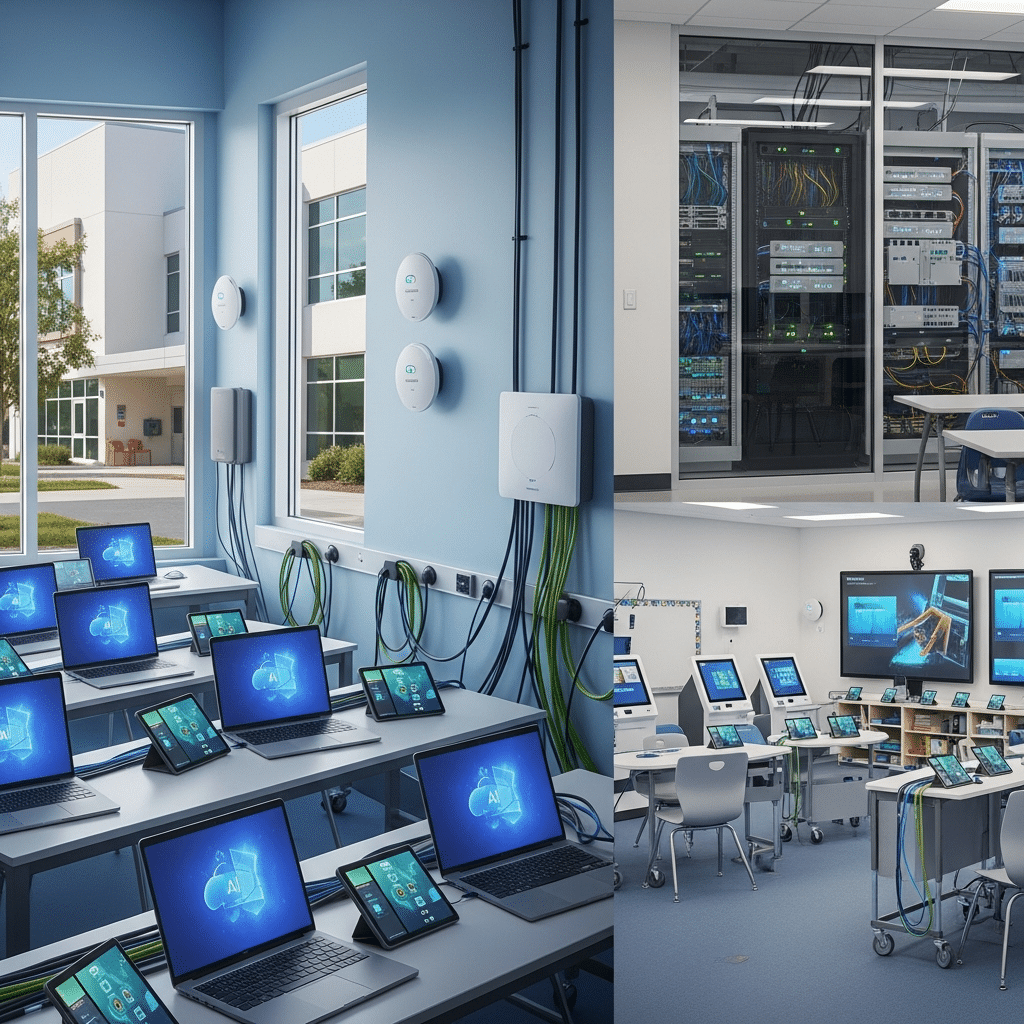
That money covers the internal connections , switching, wireless access points, cabling, UPS , that AI tools depend on. If your wireless infrastructure can’t handle the device density that AI-powered learning platforms create, no amount of software licensing will fix the experience.
Multiyear License Reimbursement
A quieter but important change: schools and libraries can now receive reimbursement for multiyear software licenses beyond the first year, as long as costs are filed correctly. This matters for districts purchasing cloud-managed networking platforms , Meraki, Aruba Central, Ruckus Cloud , where the license is baked into the operational cost.
What’s Still Not Covered
Standard E-Rate Category 2 still does not cover cybersecurity services, firewalls as standalone security devices, or endpoint protection. That’s where the FCC’s separate pilot comes in.
The FCC Cybersecurity Pilot: Separate Funding, Real Opportunity
The FCC’s $200 million cybersecurity pilot program is now issuing its first funding commitments , and demand already dwarfed supply. The pilot received $3.7 billion in requests against that $200 million allocation, as documented by the Center for Security and Emerging Technology.
This is a three-year pilot, separate from core E-Rate, focused on firewalls, advanced threat protection, endpoint security, and identity management , the controls that make AI adoption viable rather than reckless.
Important context: FCC officials have cautioned that participation in this pilot does not signal permanent E-Rate expansion into cybersecurity. Districts should pursue this funding aggressively but plan as if it’s a one-time opportunity. Build the security foundation now, then sustain it through operational budgets and future grant cycles.
For a deeper breakdown of the pilot mechanics and application process, see our coverage: Schools and Libraries Can Now Apply for FCC Cybersecurity Funding.
Where AI Delivers Value in K–12 , and What It Demands from Your Network
The most immediate AI wins in K–12 aren’t the flashy classroom tools. They’re the operational and IT functions where small teams are stretched impossibly thin.
AI-Assisted Network and Systems Management
AI-enabled network analytics move districts from reactive firefighting to proactive monitoring. These tools spot anomalies, predict capacity issues, and surface problems before they hit classrooms , as highlighted in Ruckus Networks’ discussion of E-Rate fundable emerging technologies.
In practical terms: fewer mystery outages, better visibility, faster resolution. The kind of improvements that a two-person IT team serving eight sites actually notices.
What it requires:
- Modern switching and wireless infrastructure (this is where Category 2 money applies)
- Sufficient bandwidth headroom for growing device density and cloud usage
- Clear integration with existing managed IT support and helpdesk workflows
Cybersecurity Strengthened by AI
With 82% of schools experiencing incidents and phishing accounting for nearly half of them, AI-powered threat detection isn’t a luxury , it’s the difference between catching a credential compromise in minutes versus discovering it weeks later during a forensic investigation.
AI-driven security tools can accelerate detection and response, especially when paired with foundational controls like next-gen firewalls and MFA. But these tools need clean data, proper network segmentation, and well-configured identity systems to be effective , which brings us back to the infrastructure conversation.
For districts building their AI governance framework, security architecture isn’t a separate workstream. It’s the foundation the governance sits on.
What it requires:
- Intentional security architecture spanning identity, endpoint, network, and cloud
- Upgraded perimeter security and threat detection capabilities
- Policies and training reflecting real classroom access patterns
- Alignment with district cybersecurity and compliance strategies
Classroom and Campus IoT
AI connected to IoT systems supports smart classroom operations , automated attendance, energy management, environmental monitoring. These reduce manual workload but also increase endpoint count and security surface area.
What it requires:
- Network segmentation (VLANs) to isolate instructional, IoT, and administrative traffic
- Reliable device inventory and lifecycle tracking
- Secure authentication for all device types
- Ongoing monitoring integrated with your school IT operations
Educator Readiness: The Most Overlooked Requirement
Infrastructure is the engine. Educator readiness is the steering wheel. AI only improves learning and operations when staff know what to do with it , and just as importantly, what not to do.
The Cost of Skipping Training
Even well-funded districts waste their AI investments when teachers and staff aren’t prepared. The risk isn’t just underutilization , it’s the teacher who feeds student IEP data into ChatGPT because nobody explained the privacy implications, or the admin who approves an AI vendor without checking their data retention policy.
Programs like El Paso Computes , which has trained at least 250 teachers in AI skills , provide a model that translates well to California’s multi-site districts.
What Effective AI Readiness Training Covers
From our work with K–12 leaders, the programs that stick include:
- Use-case clarity: which problems are we solving , differentiation, feedback, admin efficiency?
- Workflow integration: embedding AI into existing lesson planning and intervention processes, not bolting it on
- Data privacy red lines: what data is never acceptable to share with AI tools, full stop
- Model limitations: understanding bias, validating outputs, avoiding over-reliance
- Security hygiene: MFA, phishing awareness, safe handling of student information in AI contexts
This doesn’t turn every educator into a data scientist. It ensures the adults in the system can use AI tools responsibly, supported by clear policies and managed IT support structures. For a deeper dive on the governance side, see our K12 AI governance roadmap.
Compliance and Governance: AI Must Fit E-Rate, CIPA, FERPA, and California Law
There’s no single AI-specific regulatory framework for K–12 yet. But existing laws didn’t go away , and AI makes compliance harder, not easier.
E-Rate Compliance
AI enthusiasm can’t shortcut procurement rules. Districts must ensure AI-related solutions , especially those tied to network infrastructure , satisfy competitive bidding and audit requirements. Documentation and record-keeping aren’t optional when federal discounts are involved.
CIPA: Internet Safety Obligations
As AI tools generate content and summarize web information, CIPA compliance gets more complex. Districts need to review filtering configurations, clarify supervision expectations for AI-enabled tools, and understand how these tools interact with student accounts.
FERPA and Student Data
AI tools that handle student information , whether directly through student support systems or indirectly through analytics and behavioral signals , trigger FERPA obligations that districts can’t outsource to vendors. AI-enhanced network monitoring and E-Rate-supported security improvements can help, but only if the governance framework is in place.
California-Specific Privacy
California districts operate under SOPIPA and AB 1584, which often require stronger vendor scrutiny than federal law alone. Before adopting any AI tool, districts should verify: what data is collected, where it’s stored, whether it trains models, and how deletion requests are handled. Popular doesn’t mean compliant.
Security Controls That Enable Safer AI
For many districts, the most practical early AI win isn’t a classroom-facing tool. It’s improving security posture , MFA, identity governance, network segmentation , so innovation can happen without increasing risk. Those investments align directly with district cybersecurity roadmaps and the FCC pilot’s eligible categories.
Step-by-Step: Building an AI-Ready, Secure District
Here’s the roadmap we walk districts through when they ask, “Where do we start?”
1. Assess Infrastructure and Align to E-Rate
Start with an honest baseline. Wireless coverage in high-density areas. Switch capacity and resiliency. Internet circuit sizing. Content filtering. Identity management. Endpoint inventory , especially those 2020-era Chromebooks approaching end-of-life.
Map gaps to AI-related goals and align procurement with Form 470 and RFP timelines. With the new Category 2 budgets, a mid-sized district may have significantly more purchasing power than they realize.
2. Pursue Funding Strategically
Build technology plans that connect infrastructure upgrades to instructional goals, digital equity, and safe operations , including AI use cases.
- Maximize the new Category 2 per-student allocation ($201.57)
- Apply for the FCC cybersecurity pilot for firewalls, endpoint protection, and identity controls
- Document everything: the audit trail protects your funding
The goal is reducing total cost while building the runway AI needs , supported by experienced E-Rate consulting partners.
3. Build Educator Readiness
Use a cohort-based “train the trainer” approach. Train a first group deeply, then expand through site-based champions. Pair training with clear acceptable-use guidance, classroom-ready examples, and support structures that route technical issues to managed IT and helpdesk teams.
4. Lock Down Compliance
Before adopting any AI tool, verify E-Rate eligibility, FERPA alignment, CIPA compatibility, and California privacy compliance. Build internal processes for auditing, access control, and incident response. MFA is non-negotiable in 2026.
5. Monitor, Measure, and Scale
Define success metrics before you scale:
- Reduced helpdesk tickets related to connectivity or access
- Improved Wi-Fi performance in high-density areas
- Increased teacher adoption of approved AI tools
- Faster detection and response times for security incidents
Use these metrics in board reports, technology plans, and district IT roadmaps.
How Eaton & Associates (AIXTEK) Helps California Districts
Eaton & Associates brings 35+ years of K–12 IT experience in California, working with 50+ schools and districts across the Bay Area and beyond. We don’t sell hardware or push vendors , we help districts make decisions that hold up to audits, serve students, and don’t become shelfware.
We help districts:
- Assess AI readiness across infrastructure, security, and staff workflows
- Build E-Rate aligned modernization plans , including the new Category 2 budgets and cybersecurity pilot applications
- Navigate competitive bidding and documentation requirements to protect funding
- Strengthen cybersecurity foundations , identity governance, MFA, network segmentation, aligned with best-practice security architectures
- Develop AI governance frameworks that satisfy board expectations, state law, and federal compliance , see our AI governance roadmap for K–12
For Bay Area districts , San Mateo County, the Peninsula, and surrounding regions , our local presence means we understand the specific infrastructure challenges, budget dynamics, and regulatory environment your district operates in.
Next Steps: Schedule a School IT Assessment
If your district is exploring AI, feeling the strain of increased device density, or trying to figure out how to make the most of the 2026 E-Rate changes , now is the time to build a plan that connects security, infrastructure, and funding into a single strategy.
Recommended next actions:
- Schedule a School IT Assessment with Eaton & Associates (AIXTEK) , we’ll evaluate your AI readiness, network capacity, cybersecurity posture, and E-Rate positioning.
- Request E-Rate consulting support to maximize the new Category 2 budgets and pursue the FCC cybersecurity pilot before the window closes.
Your AI strategy is only as strong as the foundation beneath it. Build it right the first time.
FAQ: K12 E-Rate Cybersecurity and AI Readiness
What changed in E-Rate Category 2 for 2026?
The per-student budget increased from $167 to $201.57 , a 20.7% inflation-adjusted jump. Schools can also now receive reimbursement for multiyear software licenses beyond the first year. Cybersecurity remains excluded from standard Category 2 but is addressed through the FCC’s separate $200 million pilot program.
How does E-Rate support AI initiatives in schools?
E-Rate doesn’t fund AI software directly. It funds the connectivity and network infrastructure AI tools depend on , broadband, switching, wireless, internal connections. Some AI-enabled network management tools qualify as “emerging technologies” under Category 2 when they’re part of eligible infrastructure solutions. The real value is building the network foundation that makes AI tools usable at scale.
What is the FCC cybersecurity pilot program for schools?
A $200 million, three-year program separate from core E-Rate, funding firewalls, advanced threat protection, endpoint security, and identity management for schools and libraries. It received $3.7 billion in requests , massively oversubscribed. FCC officials have cautioned this doesn’t signal permanent E-Rate expansion into cybersecurity. For details, see our full breakdown of the FCC cybersecurity funding program.
What’s the biggest cybersecurity risk for K-12 schools right now?
Third-party vendor compromise and phishing. 55% of school cyberattacks originate from vendors, and phishing (including QR-code phishing) accounts for 45% of incidents. Districts managing 1,300+ apps have an enormous attack surface that most IT teams can’t fully monitor without AI-assisted tools and proper network segmentation.
How can Bay Area school districts improve IT security with limited budgets?
Start with the new E-Rate Category 2 allocation and apply for the FCC cybersecurity pilot. Focus on foundational controls first , MFA, network segmentation, identity governance , before investing in advanced tools. Partner with experienced K–12 IT consultants who understand E-Rate procurement to reduce the burden on internal staff and ensure every dollar is audit-ready.
What should a district’s AI governance framework include?
At minimum: approved tool lists, data privacy red lines (what student data never goes into AI tools), vendor vetting procedures aligned with FERPA and California SOPIPA, acceptable-use policies for staff and students, and clear incident response procedures. We cover this in depth in our K12 AI governance roadmap.
Where should districts start if they have limited IT staff?
Stabilize core infrastructure and security using E-Rate funding first. Pilot AI in one or two high-impact use cases , network monitoring and automated threat detection are good starting points because they reduce IT workload rather than adding to it. Then expand through educator training cohorts with site-based champions. Contact Eaton & Associates to discuss a phased approach matched to your budget and staff capacity.